The long-running racing franchise underwent yet another significant development with the release of Need for Speed: Carbon in 2006. The game, which was created by EA Black Box, carried on the series’ high-stakes drama, fast automobiles, and fierce street racing. But what distinguished Carbon from its predecessors was its sophisticated gaming mechanics and deep narrative, which combined racing features, car personalization, and an interesting plot that appealed to lovers of both simulation-style gameplay and arcade racing. Carbon, a member of the Need for Speed series, offered a new perspective on the world of street racing while building on the popularity of its predecessor, Need for Speed: Most Wanted.
The narrative of Carbon, which revolved around the player’s transformation from a street racer to recovering their area from a rival gang, was at its core. The story was more than just an excuse to race; it explored the intricacies of automobile culture while guiding the player through a variety of racing obstacles. The narrative unfolded through cinematic sequences that provided a window into the individuals’ private lives and hardships as well as the difficulties brought on by a bitter rivalry. Taking control of “The Canyon,” a perilous mountain route where street racers frequently met their demise, was the player’s ultimate objective. This environment enhanced the gameplay experience by adding a special sense of peril and excitement.
Many of the characteristics found in its predecessors were improved in Need for Speed: Carbon’s gameplay. One of the most significant changes was the “Crew” system, which let players choose companions with different skills. During races, these buddies might aid by blocking opponents or improving the player’s performance in particular regions. Because players had to carefully select their crew depending on their strengths and limitations, this feature added an intriguing dimension of strategy. The Crew brought a feeling of unity and strategic decision-making to the game, whether they were racing through congested city streets or navigating long, winding mountain routes.
Another noteworthy aspect of the game was its automobile customization capabilities, which carried on the practice of providing significant vehicle customizations. Nearly every component of their vehicle, including the engine, body kits, suspension, and paint job, may be altered by players. The degree of personalization affected handling and performance in addition to appearance. In addition to enabling a more customized racing experience, the option to alter cars to fit individual tastes gave drivers a sense of ownership and connection to their vehicles. It was evident that Carbon was made to appeal to gamers who enjoyed fine-tuning their vehicles for peak performance.
One of Carbon’s major novelties was the inclusion of “Canyon Races.” The player’s talents were put to the test during these races, which took place on twisting mountain roads with spectacular cliffs and tight curves. These races are among the most remembered in the game because of the harsh surroundings, which added another level of difficulty. The objective of a Canyon Duel was to take the lead and hold it through a sequence of lethal hairpin curves and elevation changes while competing head-to-head with a rival racer. With their high stakes and challenging gameplay, these races came to define Need for Speed: Carbon and added to the overall excitement of the game.
Another way in which Need for Speed: Carbon excelled was its visual design. The settings, which included a variety of urban streets, industrial zones, and mountain passes, were shown with remarkable accuracy for the era and took place in the made-up city of Palmont. A sense of speed and urgency during races was created by the lighting effects, which included the glow of city lights and the headlights of rushing automobiles. Neon lights and reflecting surfaces contributed to the game’s sleek, fast-paced atmosphere, which was another important aspect of its nighttime setting. The player had the impression that they were a part of a vibrant metropolis with danger and excitement around every corner.
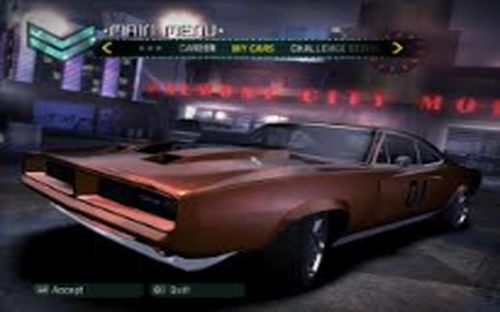
Need for Speed: Carbon’s music design was a wonderful match for the gameplay. Each race’s tone was established by the soundtrack, which included a blend of rock, hip-hop, and techno music. The fast-paced action on screen was nicely complemented by the upbeat and aggressive soundtrack, which featured songs by musicians like Death From Above 1979, Xzibit, and The Crystal Method. Each race seemed genuine because of the sounds of engines roaring, tires squealing, and the wind blowing past the player’s vehicle. The goal of Carbon’s sound design was to improve the racing experience and make it more captivating, not only to provide ambience.
System Requirements OF Need For Speed Carbon Highly Compressed PC
| Ram | 2 GB |
|---|---|
| Processor | Intel Pentium 4 2.4 GHz |
| Accessories | Keyboard, mouse, and speaker |
| Graphics card | 1 GB |
| Windows | Xp, 7, 8, 8.1, 10, and 11 |
| Free disk space | 3 GB |
Another aspect of Need for Speed: Carbon that was discussed was the AI. Each race felt different since opponents didn’t just blindly follow predetermined courses; instead, they adjusted to the player’s tactics. As the player progressed, the AI can get more hostile, particularly in the more challenging races like the Canyon Duels. Because players had to learn how to outwit and outmaneuver opponents who weren’t hesitant to block, pick, or exploit shortcuts to get an edge, the battle seemed more dynamic. It ensured that no two races ever felt the same by adding an element of surprise.
Need for Speed: Carbon has flaws despite its advantages. The game’s plot and character interaction seemed a little corny to some players, with several scenes coming off as forced or too dramatic. Furthermore, although while the driving mechanics were typically smooth, they occasionally seemed a touch stiff, especially in comparison to subsequent models in the series. Cars may occasionally appear to clip past walls or barriers without sustaining damage due to unreliable collision detection. Despite these minor problems, the game continued to be one of the best in the Need for Speed series.
Today’s racing games still bear the imprint of Need for Speed: Carbon. It established itself as one of the key games of its time by effectively capturing the excitement of street racing. Fans and racing fanatics alike were deeply impacted by Carbon’s captivating blend of narrative-driven gameplay, personalization possibilities, and fast-paced action. It offered a distinctive experience that struck a mix between arcade action and enough realism to appeal to a wide spectrum of gamers, despite its shortcomings. Because of its thrilling racing, endearing characters, and heart-pounding action, Need for Speed: Carbon is still a beloved part of the franchise.